
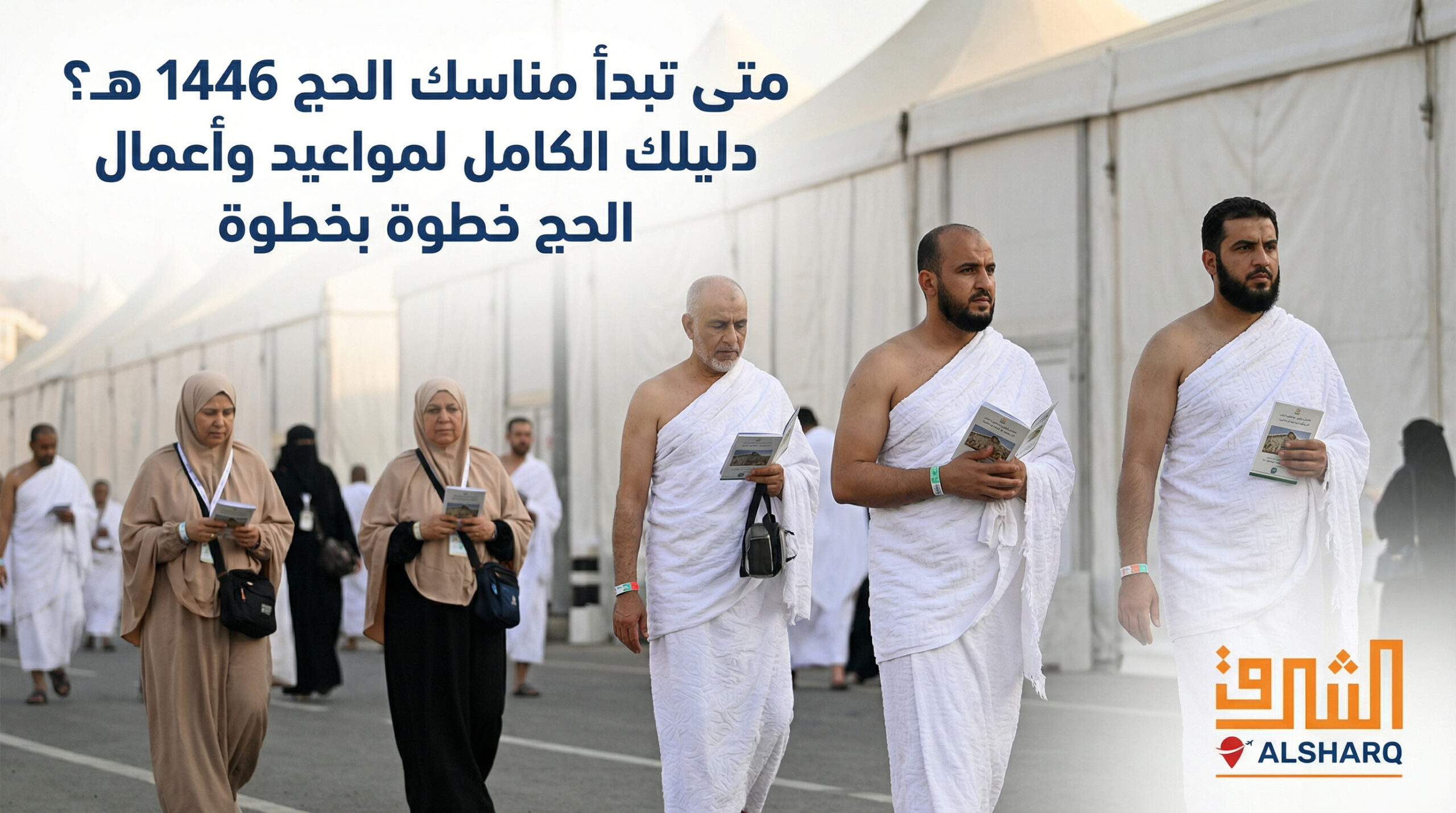
When do the Hajj rituals begin? This is a question frequently asked by those longing to visit the Sacred House of Allah and perform Hajj in the proper manner, combining spirituality and devotion. It is here that the Prophet Muhammad (peace be upon him) stood and delivered his final words, which moved the Muslim community to tears.
Muslims of all backgrounds and languages yearn to fulfill this pillar of Islam and follow the Sunnah of the Prophet (peace be upon him). The actual journey to enter the state of Hajj begins on the eighth day of Dhul-Hijjah, known as the Day of Tarwiyah.
Knowing when the Hajj rituals begin is not merely a matter of religious knowledge; it is the key to organizing a journey that begins with the obligation to perform Hajj and prepares for tranquility and standing before Allah Almighty. Therefore, in this guide, we will explore the Hajj journey in detail, from the Day of Tarwiyah to Tawaf Al-wada.
When do the Hajj rituals begin? The official start date for the Hajj rituals
The eighth day of Dhul-Hijjah, known as the Day of Tarwiyah, marks the beginning of the Hajj rituals, a journey in which the soul and body are brought into the presence of the Almighty. On this day, pilgrims move to Mina, officially commencing the Hajj. Pilgrims must enter the state of Ihram in their current location before proceeding to Mina.
Understanding when the Hajj rituals begin is not merely a matter of information sought by many; it is a form of spiritual preparation for the pilgrims. This preparation begins with the move to Mina, followed by standing on Mount Arafat and then spending the night in Muzdalifah, a journey imbued with tranquility, peace, and devotion.
The Stages of Hajj from Beginning to End According to the Islamic Calendar
The Hajj journey begins with a series of rituals based primarily on the Islamic calendar, starting with the intention to enter Ihram and culminating in Tawaf Al-wada. Pilgrims must adhere to these rituals in the order prescribed by the Sunnah. Here are the Hajj rituals in order:
1.Ihram
Pilgrimage begins before the Day of Tarwiyah, marking the start of the Hajj rituals. This pillar relies on intention, which is a fundamental condition for Ihram. Pilgrims must also abstain from prohibited acts once they declare their intention to enter Hajj.
2.The Day of Tarwiyah, the 8th of Dhul-Hijjah
As soon as the sun rises on this day, pilgrims begin arriving in Minah, where they spend the day in prayer, remembrance of Allah, and preparation for the most important pillar of Hajj: standing at Arafat.
3.Standing at Arafat, the ninth day of Dhul-Hijjah
Standing at Arafat is the greatest pillar of Hajj. As soon as the sun rises on this day, pilgrims begin their journey to Mount Arafat, raising their hands in supplication to Allah Almighty, seeking His forgiveness and mercy. The standing at Arafat ends at sunset on the ninth day of Dhul-Hijjah.
4.Spending the night at Muzdalifah, the tenth of Dhul-Hijjah
As soon as the sun sets on the ninth of Dhul-Hijjah, pilgrims begin arriving at Muzdalifah to spend the night, where they collect pebbles in preparation for the stoning of the Jamarat.
5.The Day of Sacrifice, the tenth day of Dhul-Hijjah
This day includes performing several rituals, including:
- Stoning the Jamarat al-Aqaba (the largest of the three pillars).
- Sacrificing the sacrificial animal (Hadi) for both those performing Tamattu’ and Qiran Hajj.
- Shaving or Trimming the Hair
- Tawaf al-Ifadah and Sa’i
6.Stoning the Jamarat, the Three Days of Tashreeq
The pilgrim stays in Minah in preparation for stoning the three Jamarat (the small, middle, and large pillars) each day after noon.
7.Tawaf al-Wida’, the final rite of Hajj
If the pilgrim intends to travel and leave Mecca, they must perform Tawaf al-Wida’ before departing, thus declaring the completion of the Hajj rites.
The Days of Hajj: A Step-by-Step Guide
Here is a detailed explanation of the days of Hajj and the rituals performed each day:
The Eighth Day of Dhul-Hijjah
This day includes several rituals, including:
- Going to Mina in the morning immediately after entering Ihram.
- Spending the night in Mina and drawing closer to Allah Almighty through remembrance and supplication.
- Preparing oneself for the Standing at Arafat.
The Ninth Day of Dhul-Hijjah
Among the most prominent rituals of this day is:
- Going to Mount Arafat starting from sunrise on the ninth day.
- Supplication to Allah Almighty is a day on which sins are forgiven.
- Then, on the ninth day, pilgrims move to Muzdalifah for the night, beginning to collect pebbles in preparation for the stoning of the Jamarat.
The Tenth Day of Dhul-Hijjah
Among the most prominent rituals performed on the tenth day of Dhul-Hijjah are:
- Stoning the Jamarat al-Aqaba (the largest of the three pillars) with the pebbles collected in Muzdalifah.
- Sacrificing the sacrificial animal (Hadi) for those performing Tamattu’ or Qiran Hajj. Those who do not sacrifice an animal must offer a sacrifice (Fidyah).
- Shaving or trimming the hair after the sacrifice.
- Performing Tawaf al-Ifadah (the obligatory circumambulation of the Kaaba) and Sa’i (the ritual walking between Safa and Marwa) for those obligated to perform Tawaf al-Ifadah.
The Three Days of Tashreeq
These days include performing some Hajj rituals, including:
- Stoning the three Jamarat (the small, middle, and large pillars) daily after noon.
- Staying in Mina, performing prayers, and supplicating.
- The stoning of the Jamarat can be performed on the twelfth day of Dhul-Hijjah.
Tawaf al-Wida
On this day, pilgrims perform Tawaf Al-Wida before leaving Mecca, declaring the completion of the Hajj journey by completing Tawaf.
How Long Does Hajj Take? A Comprehensive Guide to Duration and Acts
Hajj is a complete spiritual journey, beginning with Ihram and ending with Tawaf al-Wida’ (the Farewell Tawaf). The total time required to perform the Hajj rituals ranges from 5 to 7 days. Pilgrims prepare by entering Ihram through intention and abstaining from the prohibitions of Hajj. On the 8th of Dhul-Hijjah, they move to Mina, where they spend the day in remembrance and prayer.
With the sunrise of the 9th of Dhul-Hijjah, the standing at Arafat begins. As soon as the sun sets, pilgrims proceed to Muzdalifah to spend the night in preparation for the stoning of the Jamarat.
On the 10th of Dhul-Hijjah, the Day of Eid, pilgrims begin by stoning the Jamarat al-Aqaba (the largest of the three pillars), followed by the sacrifice of the sacrificial animal (Hadi).
After completing the sacrifice, they shave or trim their hair, then perform Tawaf al-Ifadah (the obligatory circumambulation of the Kaaba) and Sa’i (the ritual walking between Safa and Marwa).
With the start of the three days of Tashreeq, the stoning of the three Jamarat begins each day after noon. Pilgrims are permitted to perform the stoning on the 12th of Dhul-Hijjah. The Hajj concludes with Tawaf al-Wida’. A complete spiritual journey combining tranquility and submission to Allah Almighty.
When do pilgrims begin Ihram? The correct time for Ihram for Hajj
It is worth noting that Ihram for Hajj begins at the designated Miqat for each region. This is the legally prescribed time when the pilgrim must declare their intention to enter the Hajj rituals, while adhering to the prohibitions associated with Ihram. For most pilgrims, Ihram is entered before the Day of Tarwiyah or on the morning of the Day of Tarwiyah (8th of Dhul-Hijjah), which marks the actual beginning of entering the holy sites.
Ihram is a fundamental stage in Hajj, as it separates the ordinary from the sacred, placing the pilgrim in a special spiritual state that lasts throughout the journey until the completion of Tawaf Al-wada. Adhering to the correct time for Ihram is not limited to timing alone, but also includes having the correct intention, wearing the Ihram garments.
And preparing oneself to perform the rituals step by step, starting from Mina, passing through Arafat and Muzdalifah, and ending with the stoning of the Jamarat and Tawaf Al-wada.
Book your trip with AlSharq Company now!
Prepare to perform Hajj rituals with complete comfort and peace of mind with AlSharq Company. We offer fully organized trips that include accommodation, transportation, and comprehensive guidance throughout the Hajj. Don’t miss the opportunity to perform the greatest pillar of Islam with ease and convenience. Book your trip today and begin your spiritual journey with us!
Conclusion
Regardless of the details regarding the timing of Ihram and movement between the holy sites, the goal remains the same, reaching the greatest pillar of Hajj standing at Arafat. On the ninth day of Dhul-Hijjah, hearts and tongues unite on one plain, as the pilgrim reaches the pinnacle of their spiritual journey, without which Hajj is incomplete. With the end of this standing, the soul finds tranquility, and the journey of forgiveness begins, culminating in the remaining rituals. Thus, from the moment Hajj begins on the Day of Tarwiyah until the moment of standing at Arafat, the pilgrim experiences the greatest spiritual journey of their life, a journey in which pure pages are written between the servant and their Lord.
FAQs
When does Ihram for Hajj begin on the specified days?
The state of ihram for Hajj officially begins on the eighth day of Dhul-Hijjah. However, it is also permissible for the pilgrim to begin ihram a day or two earlier, provided they adhere to the intention and the prohibitions of Hajj.
Does Hajj begin before the Day of Tarwiyah?
Hajj can begin before the Day of Tarwiyah, but the actual rituals of Hajj commence on the Day of Tarwiyah when the pilgrims proceed to Mina.
When do the pilgrims begin their journey to Arafat?
The pilgrims proceed to Arafat on the ninth day of Dhul-Hijjah. The standing at Arafat begins at sunrise and ends at sunset.
When does Hajj officially end after the completion of the rituals?
After completing the stoning of the Jamarat and performing the Tawaf al-Wida, the actual end is at the conclusion of the Days of Tashreeq.
What is the latest time to perform the Tawaf al-Wida?
If the pilgrim intends to travel and leave Mecca, they must perform the Farewell Tawaf immediately before departing.
Discover more about the offers: Hajj offers
Need more information: About us
Need help : Contact us